Reforming our voting system
The Reform Movement in 2026
We start 2026 with the hope of progress towards voting reform. The Elections Bill proposes reducing the voting age to 16, reviewing voter ID, improving voter registration and strengthening political donation rules – but makes no mention of the reform most needed that of a more proportional voting system!
Public support for PR is at a record high of 60% [Social Attitudes Survey, June 2025]. In December 2025 a petition for voting reform achieved over 250,000 signatures!
MPs are increasingly aware that in multi-party Britain our voting system is failing. It’s been termed a “slot-machine” system giving random and unpredictable results.
The All Party Parliamentary Group for Fair Elections, with over 150 MPs, is campaigning for an Electoral Commission on Voting Reform. If set-up this would signal real progress towards voting reform.
Under our First past the Post (FPTP), also called Winner takes all, voting system, most people’s votes don’t count. People who live in a so-called safe seat can vote for the losing party all their life so their vote never counts. So many people, understandably, don’t bother to vote at all because their vote makes no difference. No wonder some people give up voting altogether!
Under the FPTP system the importance of your vote depends on where you live! Some people’s votes are more important than others, depending by pure chance on where their constituency boundary line is drawn. These important voters in marginal seats decide who governs the country. Voters for the likely loosing party in safe seats have to decide whether to vote for their party or vote tactically. This means voting for their least worst choice based on guesswork.
Ultimately the winning Party, without getting a majority of votes, gets absolute power. This is a distortion of democracy!
There is a solution – the voting system should reflect our values as a country. Values of fairness and equal representation. We campaign for a voting system were all votes count equally and seats match votes. It’s called Proportional Representation (PR). Under PR you vote for who you want. You vote with your heart and not your head. Under PR every vote will contribute to the election of somebody that the voter wants – so voting will make a difference!
The Impact of Proportional Representation
PR systems produce Parliaments that are more diverse and representative of peoples’ views. These Parliament rely on co-operation and collaboration between political parties. This leads to better decision making reflected in better long-term policies, for example on the environment, social care and workers’ rights.
PR increase voter turnout because every vote matters.
Most European countries use PR and none are considering changing to FPTP! Proportional Representation is well established in the UK voting system. It’s used for elections to the Northern Ireland Assembly and to the Scottish and Welsh Parliaments.
New Zealand is a good comparison for the UK. In 1993 New Zealand held a referendum and voted to change to PR. Eighteen years later they held another referendum and voted to keep PR and not return to FPTP.
The distorting effect of FPTP
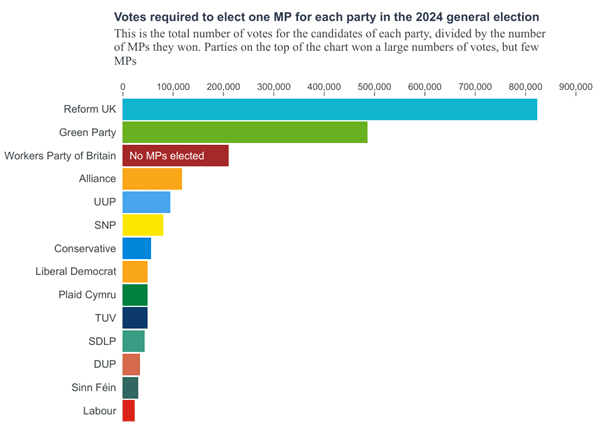
The distorting effects of FPTP in 2024 led to the governing party (Labour) having 63% of votes with just 34% of votes. This was the most disproportionate UK general election result in history.
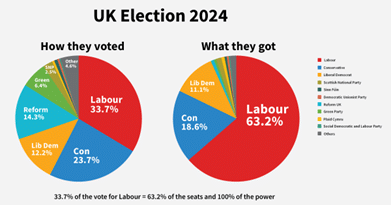
The number of votes required to elect an MP varied dramatically from 23,600 for a Labour MP to 820,000 for a Reform MP. This feeds into peoples’ distrust with politics and feeling that they system isn’t working for them.
Multi-party politics and fair representation.
First past the post was designed to maintain a system were two Parties dominated. This is no longer the case. We have many parties and our flawed voting system can’t cope. If we don’t introduce a PR system were everyone feels represented then distrust and alienation will increase.
Some argue that PR would give more MPs to populist or extremist parties. But being unfairly represented in Westminster feeds into their perception that the system is against them. PR actuallyoffers
protection against extremism because under FPTP a populist party could win total power on as little as 30% of the vote. This wouldn’t be possible under PR. We shouldn’t compromise our democracy because of unwarranted fears of extremism.
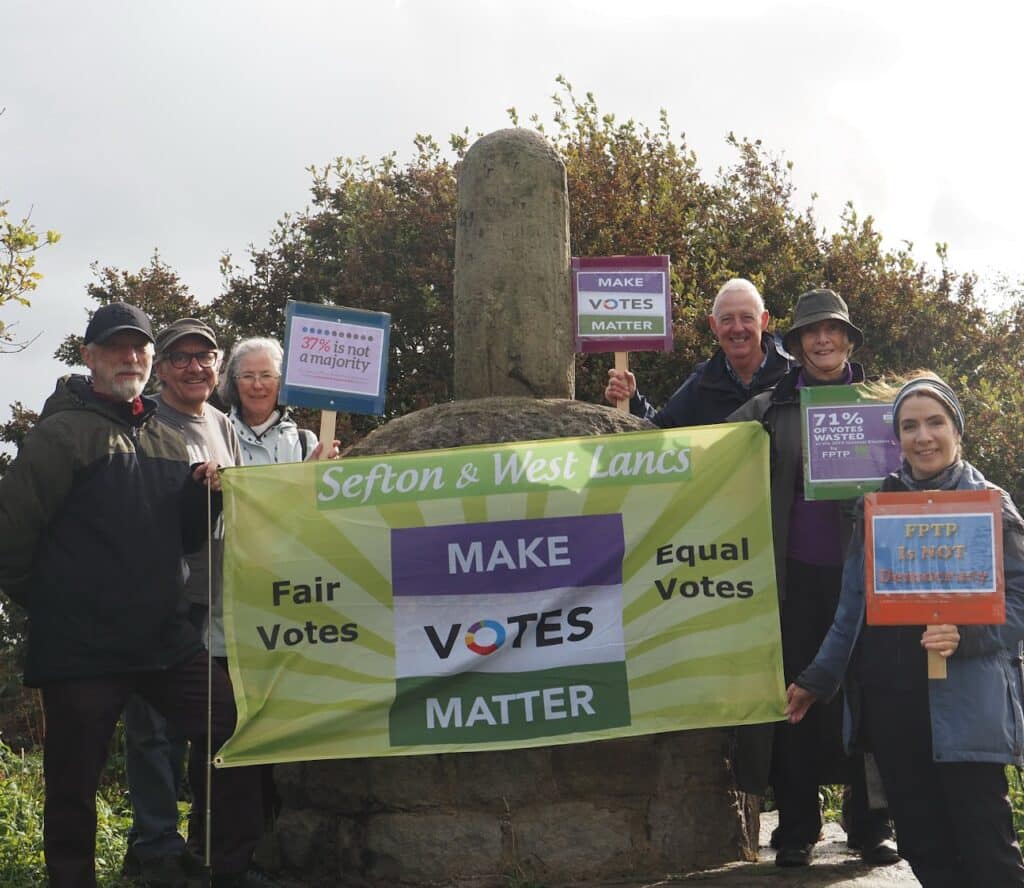
Democracy is a journey not an event. The Parbold Bottle built in 1832 represents the start of that journey. Along the journey we’ve had four Reform Acts. In 2026 we are campaigning for a fifth Reform Act to introduce Proportional Representation.
If you feel the same please join our campaign!
Make Votes Matter is the movement for Proportional Representation. It’s a non-party political campaign for PR.
If you would like to get involved in our grassroots campaign contact MVM Sefton and West Lancs via MVM.sefton.wl@gmail.com or via the Facebook page linked to this website.